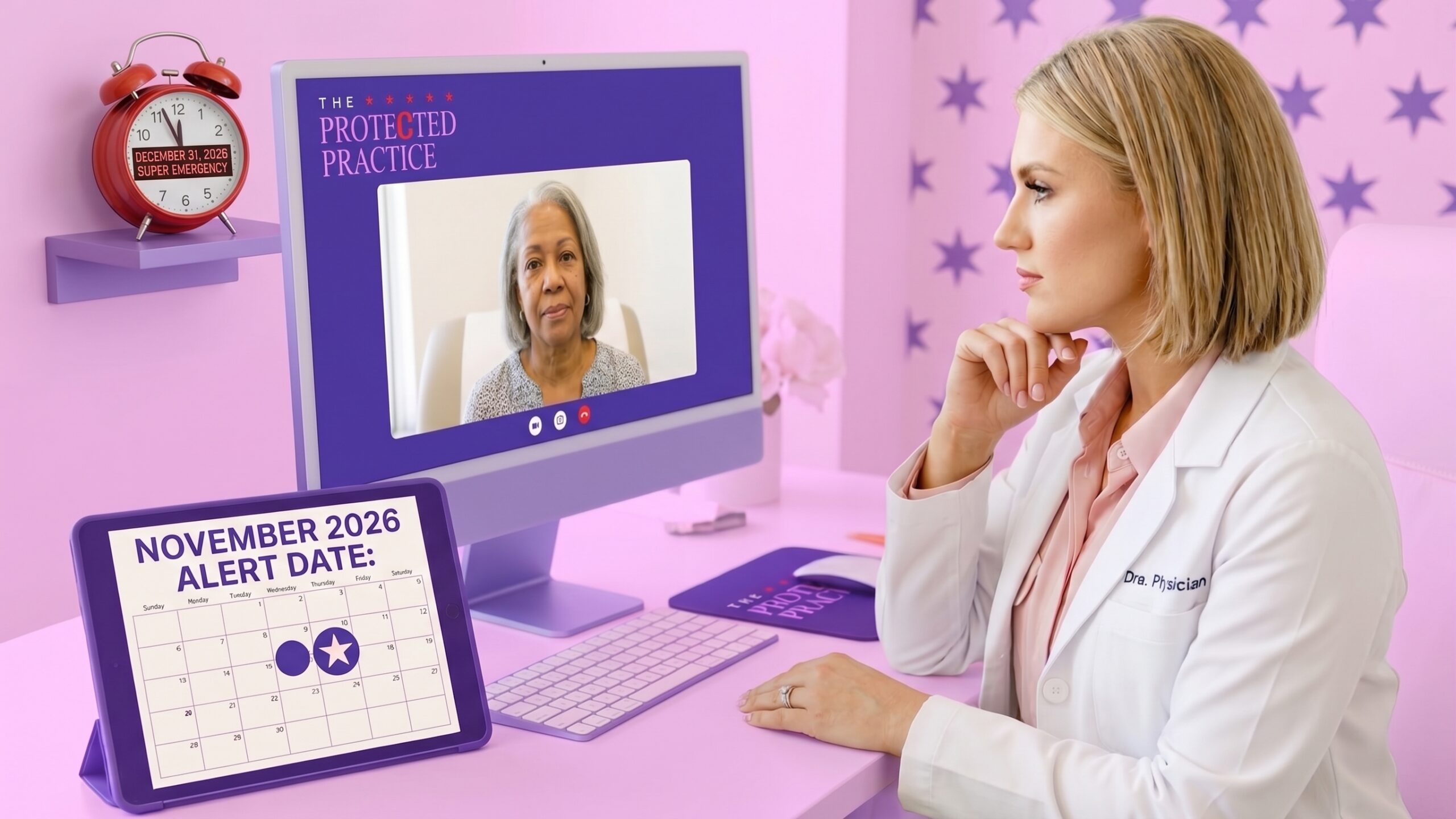

Sometime in November and December 31. Those are the two dates DEA telehealth prescribing now runs on.
One of those is a target and the other is the cliff.
On August 25, 2026, the DEA sent its final rule on Special Registrations for Telemedicine to the White House Office of Management and Budget. OMB confirmed receipt the same day. That is the last procedural stop before a rule publishes.
Back in July I wrote that the DEA had handed telehealth prescribers another year which was quickly coming to an end, and that the worst thing you could do with it was coast. This is the part where the coasting stops being free.
What actually happened to the DEA telehealth prescribing rule
OMB review is not a formality, but it is the end of the road. A rule sitting at OMB is a rule the agency considers finished. What happens next is interagency review, then publication. The final framework for DEA telehealth prescribing is already written. You just cannot read it yet.
The DOJ’s own regulatory agenda targets November 2026.
The current telemedicine flexibilities, the ones letting you prescribe Schedule II through V without a prior in-person visit, expire December 31, 2026.
Do that math and you get the actual problem. If the rule publishes in November as forecast, you have roughly six weeks to read a brand new federal registration framework, decide which category applies to you, and implement it before the thing currently keeping you legal switches off.
Six weeks. Over the holidays. For a multi-state telehealth practice, that is not a compliance project. That is an absolute emergency.
What nobody knows yet, including me
Here is your warning from your friend who is an attorney. There is going to be a lot of confident writing about this over the next two weeks.
The final rule text is not public. The notice OMB received does not include it. Nothing has been published. Every description of the new requirements circulating right now, including the one you are about to read, is describing the January 2025 proposed rule and assuming it survived largely intact.
Final rules routinely differ from proposals in ways that matter. So read the next section as what people are working from, not as what the law will say.
So what does the proposed rule actually say?
Since that proposal is the only text anyone has, it is worth knowing what it proposed for DEA telehealth prescribing rather than nodding along to a summary. Here is the structure as proposed.
DEA telehealth prescribing would split into three registrations, not one
The first is a Telemedicine Prescribing Registration, for clinician practitioners, covering Schedule III through V. This is the one that would cover things like testosterone and ketamine.
The second is an Advanced Telemedicine Prescribing Registration, covering Schedule II through V. This one requires showing specialized training and legitimate need, and as proposed it is limited to a named list: psychiatrists, hospice and palliative care physicians, long-term care practitioners, pediatricians, neurologists, and board-certified mid-levels in those specialties.
Read that list again and notice who is not on it. Aesthetics is not there. Weight loss is not there. Hormone and wellness practices are not there.
The third is a Telemedicine Platform Registration, for online platforms dispensing Schedule II through V through registered clinicians. As proposed, the platform itself carries an obligation to oversee its prescribers and build safeguards against diversion. If you operate a platform rather than a practice, that is a duty you would own directly.
DEA telehealth prescribing across state lines
The proposal adds a Limited State Telemedicine Registration for prescribing into additional states. Proposed fees were $50 for clinician practitioners and $888 for platforms. The money is not the story. The story is that a multi-state telehealth practice would be tracking a stack of state registrations rather than one federal credential.
The PDMP obligation gets wider over time
At the start, you would check the PDMP in the state where the patient is, the state where you are, and any jurisdiction with a reciprocity agreement, looking back a year where a year is available. After three years, that expands to all U.S. jurisdictions, contingent on a nationwide database existing.
Audio-only gets narrow
For Schedule III through V, you could use audio-only only where you have video capability and the patient cannot use it or declines. You would have to start treatment by audio-video, and you would need to have conducted at least one audio-video exam of that patient.
And then there is Schedule II, where it gets strict
Two things. You would have to be physically located in the same state as the patient at the time of the encounter. And the DEA would cap your telemedicine Schedule II prescriptions, averaged monthly, at less than 50 percent of your total Schedule II prescribing.
That second one is the sleeper. It is not a rule about any individual prescription. It is a rule about the shape of your whole practice, and a practice built primarily on DEA telehealth prescribing of Schedule II would fail it on volume alone, no matter how good any single encounter was.
Also worth noting: applicants would list a physical address as their registered location, and would need to be physically inside the United States when issuing a telemedicine prescription.
The part that should worry a convenience-based practice
Here is my read, and it is the thing I have not seen anyone say out loud.
Look at how the proposal describes who the basic registration is for. Patients for whom an in-person exam would be burdensome. The examples given are severe weather, remote locations, and communicable disease.
That is access language. It frames DEA telehealth prescribing as an accommodation for people who genuinely cannot get to a clinic.
A great many telehealth practices in this space are not built on that. They are built on convenience, which is a completely legitimate business and also a different thing. If the final rule keeps that framing, the question is not only whether you can register. It is whether the model you actually run is the one the registration is meant to serve.
I do not know how that resolves. Nobody does yet. But if you run a convenience-first telehealth model, that framing is the sentence I would be watching for when the text drops.
Why waiting on the DEA telehealth prescribing text is the wrong instinct
The reasonable-sounding plan is to wait until November, read the rule, then act. Why build for requirements that might change.
Here is the problem. Look back at what the proposal actually asks for. Where your prescriber is physically located. Which states you prescribe into. Whether anyone checked a PDMP, and in which jurisdictions. Whether the encounter ran audio-video, and whether your chart shows it. What share of your Schedule II prescribing runs through telemedicine.
Every one of those is a question about what you already do. None of the answers depend on the final text. And all of them take longer than six weeks to reconstruct if the honest answer today is that you would have to go look.
The practices that will have a bad December are not the ones that guessed wrong about the rule. They are the ones who cannot currently describe their own DEA telehealth prescribing workflow in writing.
What to do now about DEA telehealth prescribing
- Write down every controlled substance your practice prescribes via telehealth, and under whose DEA registration. If you operate in multiple states, do this per state.
- Document what a patient encounter actually consists of today. Audio-video or not. What is captured. Where it lives. Pull three real charts and see whether they show what you think they show.
- Find out whether anyone checks a PDMP before prescribing, and whether that check leaves a record. In a lot of practices the answer is yes to the first and no to the second.
- Identify who owns this if the rule lands in November. Not the practice. A person, by name, with the calendar time to do it.
- Plan for the ugly branch. If the rule slips past December 31 and the flexibilities lapse without a replacement, what happens to your patients on January 2? Decide that now, while it is hypothetical.
What to watch
Whether the rule clears OMB and publishes on the November target, and whether the DEA issues another short extension as a bridge if it does not. Both are live possibilities. Watch the OMB review status rather than waiting for a headline, because the movement will show up there first. Everything about DEA telehealth prescribing after January 1 turns on which of those two happens.
If this is you
This is the part of the practice that is easy to leave until it is urgent, because it works fine right up until it does not.
If you are prescribing controlled substances over telehealth and could not, today, hand someone a one-page description of how that actually works in your practice, that is the project this month. Not because the rule is scary. Because six weeks is not enough time to build documentation you should already have.
Court Approved Council helps private-pay practices get that written down while the deadline is still theoretical.
Come join us inside The Protected Practice.
Real compliance strategy from a real attorney.
Y’all stay protected out there.
Court Approved Council is owned by Court Approved, PLLC and is not a law firm. Nothing here is legal advice and no attorney-client relationship is formed.


+ show Comments
- Hide Comments
add a comment