
Everybody is staring at the $4.5 million. Wrong number. If you run an MSO structure, the number that should scare you is $100,000.
On June 26, 2026, California Attorney General Rob Bonta announced a settlement with Carbon Health Technologies, its affiliated medical groups, and co-founder and former CEO Eren Bali. Big number, real headline, fine. But the settlement also does something enforcement documents rarely do this plainly. It names, feature by feature, which parts of a friendly PC structure crossed the line.
If you run a med spa, a hormone clinic, or a weight-loss practice under an MSO structure, that list is worth considerably more to you than the fine is. It is, functionally, a free structural review of your own paperwork, run by the office most aggressive about California corporate practice of medicine in the country. You just have to be willing to hold it up against your own agreement.
That is the part people skip.
What happened
Carbon Health delivered care through affiliated physician practices, the arrangement most people call a friendly PC or an MSO-PC model. A management company on one side, a physician-owned professional corporation on the other, joined by contracts.
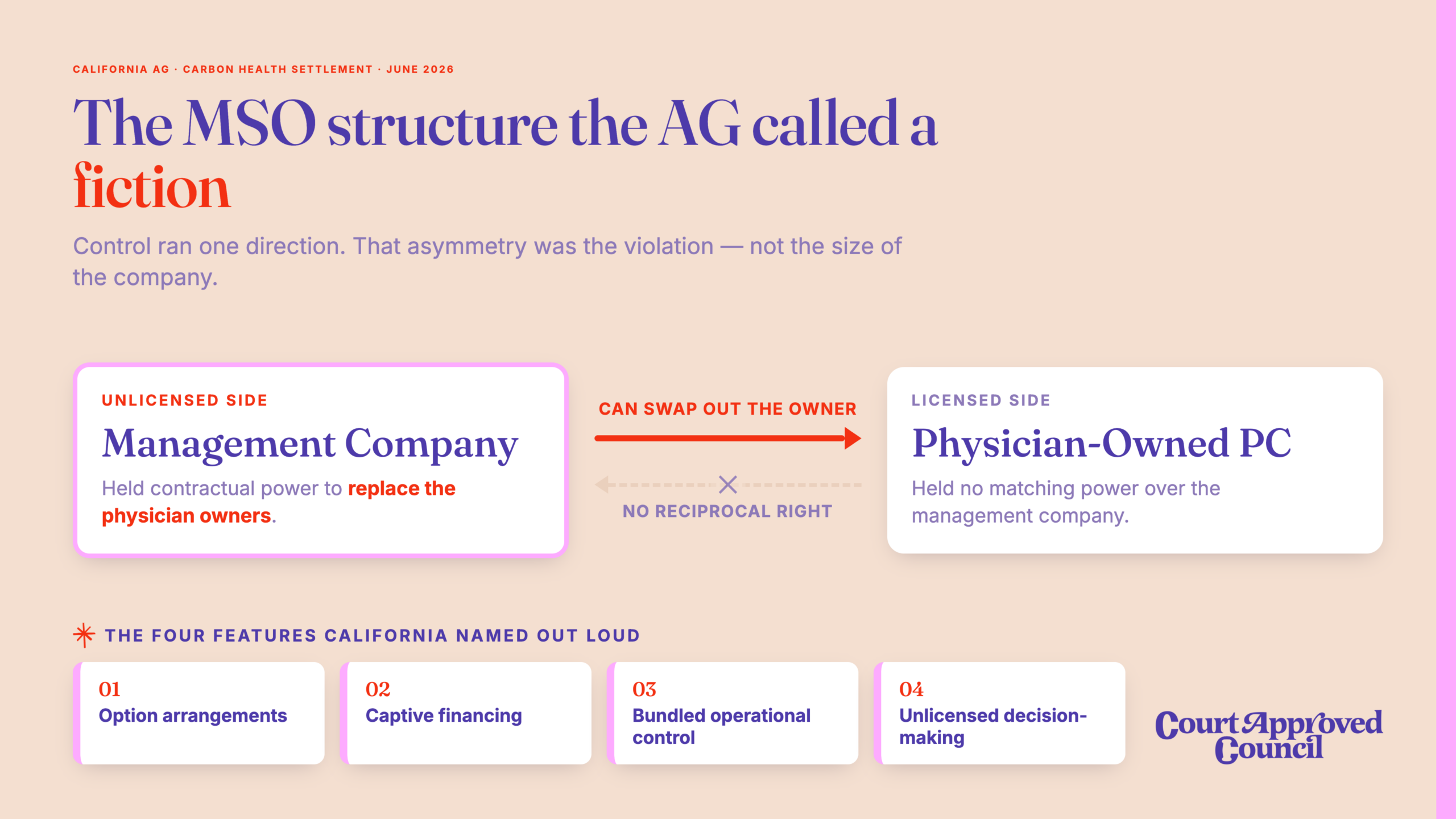
The AG alleged the separation was a fiction. Per the AG’s own announcement, the management company held contractual power to replace the physician owners, while the physicians held no matching power to replace the management company. The settlement also covered false advertising about insurance coverage and in-network status, unclear consumer contracts, and billing problems including hidden automatic charges, overcharges, and duplicate bills.
The remedy is the part to read twice. Carbon Health has to change its organizational structure so that a non-medical management company can no longer control or hold ownership interests in physician-owned medical practices. That is not a check you write and move on from. That is a rebuild.
The MSO structure features California named out loud
Here is the useful part, and the reason I would rather you read the settlement than the coverage of it. Based on the settlement and the AG’s description of the conduct, these are the features that drew fire:
- Option arrangements letting the management company swap out the physician owner, with no reciprocal right running the other direction
- Financing that leaves the PC economically captive to the MSO
- Operational control bundled together across hiring, firing, compensation of licensed staff, advertising, billing, and payer negotiations, all sitting on the unlicensed side
- Unlicensed people holding real decision-making power over clinical matters
Four things. Named. You now know what an attorney general in the most active enforcement state in the country thinks is over the line, and you did not have to get investigated to find out.
Note the operative word in that third one, though, because it does a lot of work. Bundled. The concern was the whole package landing on the unlicensed side, not the existence of a management agreement. An MSO that assists the practice, at the physician’s direction, with the physician holding genuine approval rights, is a different animal from one that simply decides.
Why this is your problem too
I can hear the objection. Carbon Health had scale and venture funding. You have three injectors and a hormone clinic in a strip center. Different universe.
Not on this one. The AG did not go after Carbon Health for being big. Size was never the violation. Structure was. And structure is the one thing you and Carbon Health genuinely have in common, because odds are decent you both bought yours from the same place. A template.
Go look at your own documents against those four bullets. If you are operating under an MSO structure, I would bet actual money at least two of them are sitting in your agreement right now, because they are close to default terms in a great many of the forms sold into this industry.
Great news, I guess?
What happens if you skip the assignment
This is where the numbers earn their place.
$4.4 million came from the Carbon Health entities. $100,000 came from Eren Bali. Personally. Not the company on his behalf. Him.
Carbon Health’s Chapter 11 did not stop the AG either. And the remedy required unwinding what already existed, not just behaving going forward. So we will clean it up at the next restructure is not a plan, it is a hope.
A corporate structure that does not shield the individual who signed off on it changes the math for every founder reading this. That is the sentence I would underline.
This is a pattern, not one angry filing
Look at the run out of that office: an amicus brief defending California’s CPOM ban in April 2026, a corporate practice of dentistry settlement with Aspen Dental in May, Carbon Health in June. Three moves in three months from an office that has clearly built a pipeline and knows what it is hunting.
California is not alone. I covered New York going after med spa structure on July 1. Two of the largest states in the country, same year, same target. When two states independently decide your org chart is the interesting part, that is a pattern.
For the general version of why healthcare ownership works differently from every other business you have run, I wrote that one back in January.
What to do now
- Pull your MSO agreement and read the option and transfer provisions. If the management side can replace the physician owner and the physician owner cannot replace the management side, that asymmetry is the feature the AG hit hardest.
- Confirm your PC can borrow from someone other than your MSO. Exclusive financing on non-market terms reads as captivity.
- Map who actually decides. Clinical hiring and firing, clinical compensation, advertising claims, billing. If the unlicensed side holds all of it, the bundle is the problem more than any single item in it.
- Look at your governance on paper and in practice. What unlicensed individuals may do in officer or board roles varies by state and by the specifics, so have that checked rather than assumed.
- If your structure was built before 2024, or built from a form written for Texas or Florida, have it reviewed against California specifically. Surviving in a state with no active enforcement is not evidence of much.
What to watch
Whether other attorneys general copy the personal liability move. Also how the Art Center Holdings litigation develops, since California’s courts are being asked to draw these lines too.
If this is you
If your practice runs on an MSO-PC structure and nobody has read those documents against 2026 enforcement, that is your project this quarter. Court Approved Council helps private-pay practices pressure-test their CPOM and MSO structure before someone else does.
Come join us inside The Protected Practice.
Real compliance strategy from a real attorney.
Y’all stay protected out there.
Court Approved Council is owned by Court Approved, PLLC and is not a law firm. Nothing here is legal advice and no attorney-client relationship is formed.


+ show Comments
- Hide Comments
add a comment