Texas Medical Board Enforcement Trends: What Clinics Need to Know
I'm Courtney!
As a legal expert and business strategist, I’m here to help you navigate compliance with ease and build a thriving medical aesthetics practice.
hey there
When a Texas Medical Board (TMB) investigation shows up on a clinic’s horizon, it rarely arrives as a surprise.
Instead, enforcement trends emerge long before the notice lands: complaints filed, documentation gaps appear, supervision or delegation questions arise, and patterns start to form.
For clinics operating in Texas, these enforcement trends are not theoretical. They shape how providers are supervised, how delegation is structured, and how compliance systems are evaluated under scrutiny.
Who Needs to Be Paying Close Attention to This
If you own or operate a healthcare clinic in Texas—whether primary care, specialty practice, outpatient facility, or multi-provider organization—TMB enforcement trends already affect you.
This includes clinics that employ physicians, nurse practitioners, physician assistants, and registered nurses. Enforcement isn’t limited to “bad actors” or isolated misconduct. Trends show that common structural and operational issues are often the earliest triggers.
What This Means for Clinic Owners
The Texas Medical Board enforces medical practice standards to protect patients and public health. Its authority includes investigating complaints, imposing disciplinary action, and publicly documenting enforcement actions.
For clinics, enforcement data is a real indicator of what patterns and actions draw attention. Understanding these trends helps clinics identify potential exposure points before a board shows up.
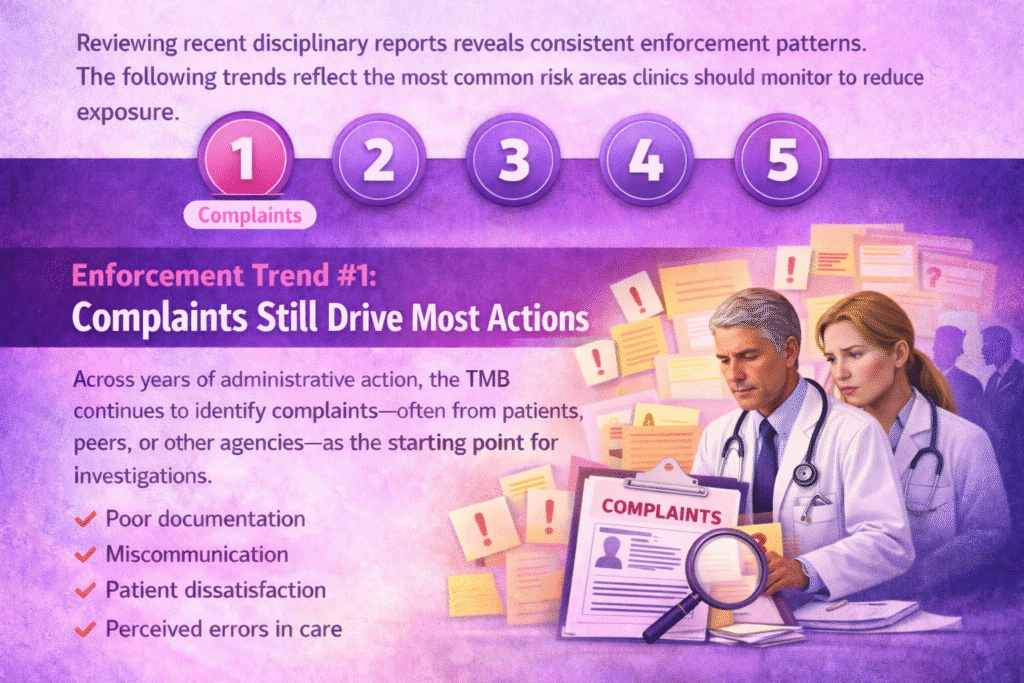
The following trends reflect the most common risk areas clinics should monitor to reduce exposure.
Enforcement Trend #1: Complaints Still Drive Most Actions
Across years of administrative action, the TMB continues to identify complaints—often from patients, peers, or other agencies—as the starting point for investigations.
Complaints may allege misconduct, but they often stem from:
Poor documentation
Miscommunication
Patient dissatisfaction
Perceived errors in care
While not all complaints have merit, they trigger reviews that evaluate patterns of practice—not just the isolated event.
The TMB provides public information on complaint & discipline information that demonstrates how frequently this trigger leads to enforcement.
Enforcement Trend #2: Scope of Practice Issues Are Visible Triggers
Medical boards, including the TMB, increasingly examine whether providers are working within their legal authority. Questions about who can do what often surface in enforcement contexts.
When a clinic’s workflows don’t align with scope of practice variation that creates exposure, boards find patterns that look like unauthorized practice—not simply clinical error.
Trending enforcement categories include allegations that providers performed tasks outside their legally permitted scope without appropriate supervision or delegation documented.
Delegation and supervision issues remain a consistent theme in enforcement cases—especially where delegation is unclear or oversight is undocumented.
When non-physician providers are involved, the Board’s review often asks:
Who assigned the task?
Who supervised the activity?
Was the delegation within legal authority?
These questions reflect delegation and supervision failures clinics overlook and often trace back to documentation gaps rather than intentional wrongdoing.
Nothing triggers deeper questions from the TMB like incomplete, inconsistent, or missing documentation.
Boards use documentation not just to evaluate clinical decisions but to confirm supervision, delegation, and authority. If records do not show how decisions were authorized or who oversaw delegated tasks, enforcement activity tends to escalate.
Another recurring theme in enforcement actions involves licensing and credentialing:
Expired or lapsed licenses
Providers practicing before proper credentialing
Incorrect scope on clinical privileges
These issues may seem administrative, but they trigger enforcement activity when clinics are unable to demonstrate authority at the time of an event.
Why Clinics Are Still Surprised
Many clinics assume enforcement only affects providers with egregious misconduct.
But enforcement trend data from the TMB shows that:
Structural issues
Authority ambiguities
Inconsistent supervision documentation
Poor delegation practices
…are just as likely to trigger scrutiny as clinical errors.
This is where corporate practice of medicine risks clinics overlook often intersects with enforcement patterns, especially in clinics with diversified services or complex ownership.
What the Board Looks for Once Enforcement Begins
Once a case is opened, the Board’s authority allows it to examine:
Clinic policies
Supervision and delegation documentation
Provider scopes and credentials
Patient records, including charting patterns
This is where clinics with strong foundational systems perform best—not because they never make mistakes, but because they can show how compliance is structured.
How Clinics Can Respond to Trends Proactively
Clinics that stay ahead of enforcement trends typically:
Align staffing and authority with state law
Clarify delegation and supervision pathways
Document systems—not just events
Review structural policies regularly
This proactive approach builds confidence and reduces exposure when patterns inevitably change.
How Court Approved Council Helps Texas Clinics
Texas enforcement trends can feel unpredictable—but they don’t have to be.
Court Approved Council helps clinics:
Identify risk patterns before they escalate
Clarify supervision and delegation structures
Align clinic governance with evolving regulatory expectations
Strengthen documentation systems that hold up under review
Preparation is not about eliminating risk entirely. It’s about making sure that when scrutiny occurs, your clinic can demonstrate compliance confidently and defensibly.
The Real Takeaway
Texas Medical Board enforcement is not random. Trends show patterns—and those patterns reveal risk points that clinics can address early.
Clinics that understand what triggers enforcement can reduce exposure. Clinics that ignore trends often learn the rules when someone external starts asking questions.
Understanding enforcement trends helps clinics grow with confidence—not correction.
I’m the one who makes the overwhelming stuff—like compliance and regulations—feel totally doable. Need an action plan? I’ve got you. Want to automate the boring stuff? Let’s make it happen.
As the founder of Court Approved Council and co-creator of a multi-million-dollar medical aesthetics company, I know what it’s like to juggle it all. That’s why I’ve created affordable, accessible tools and strategies to help you simplify compliance, save time, and grow your business with confidence.



+ show Comments
- Hide Comments
add a comment