

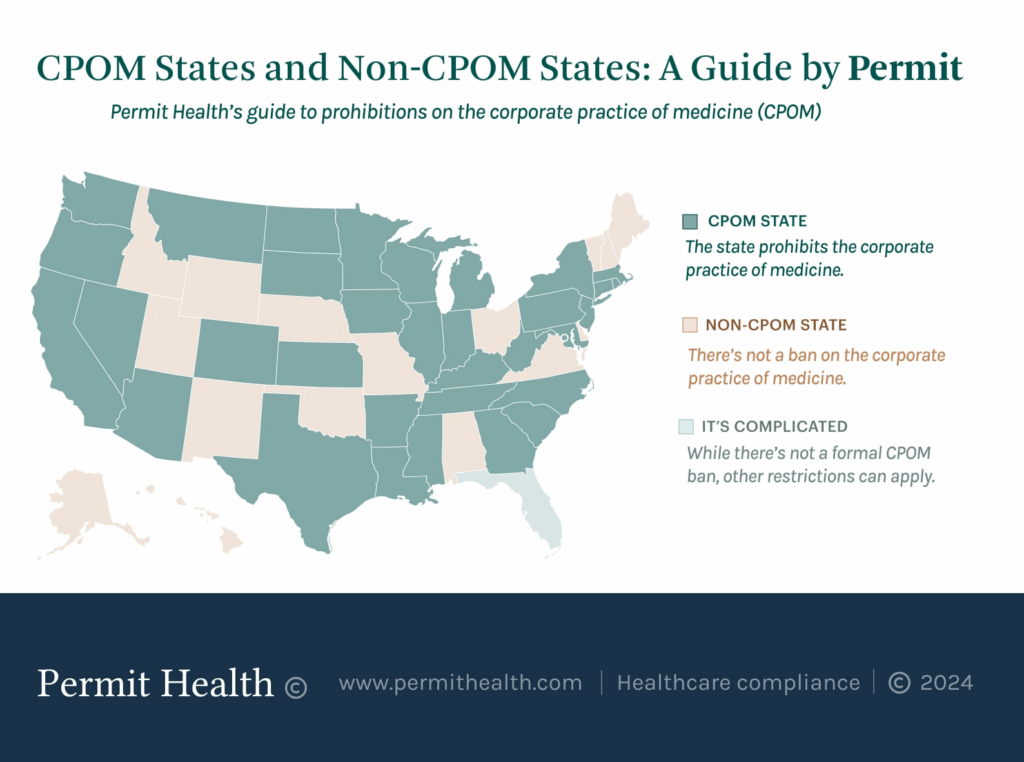
Source: The Corporate Practice of Medicine 50-State Guide
Most healthcare founders won’t hear about this until it’s too late.
Their aesthetic clinic is profitable. Patients are happy. Growth looks steady. Then—often during financing, an audit, or an attempted sale—someone asks a question that suddenly changes the tone of the room:
“Who actually owns and controls the medical practice?”
That question sits at the heart of the Corporate Practice of Medicine doctrine (CPOM). And while it sounds abstract, CPOM is one of the most common reasons aesthetic founders discover their business is exposed—long after the structure is already in place.
Who Needs to Be Paying Close Attention to This
If you’re a healthcare founder or aesthetic clinic owner, CPOM applies to you the moment you accept medical revenue without being a licensed physician.
This includes med spas, injectables clinics, wellness centers, and any hybrid model that blends medical services with consumer branding.
It matters even more if you plan to expand into another state, bring on investors, or exit within the next few years. CPOM problems rarely show up on day one. They surface when scrutiny increases.
The One-Minute Reality Check Most Founders Need
Corporate Practice of Medicine laws decide who is legally allowed to own and control a medical practice.
They affect:
- Ownership structure
- Control over clinical decisions
- How revenue is distributed
- Whether contracts hold up under review
Because there is no federal CPOM law, every state approaches this differently. Some states are strict. Others are permissive. Many fall somewhere in between. This state-by-state inconsistency is why founders are often shocked to learn that their setup—perfectly acceptable in one state—can be noncompliant in another.
A clear overview of Corporate Practice of Medicine laws by state shows just how uneven enforcement really is.
What CPOM Actually Means (Without Legal Noise)
At its core, CPOM exists to prevent business interests from influencing patient care.
In states that enforce CPOM:
- Only licensed physicians (or physician-owned entities) can own medical practices
- Non-physicians cannot control clinical judgment
- Business operations must be carefully separated from medical authority
The doctrine doesn’t prohibit non-physicians from building successful healthcare businesses. It simply forces them to do so through compliant structures, not direct control.
This is why healthcare ownership is regulated differently from other industries, especially in states that view medicine as a profession first—not a commodity. The reasoning behind this is well explained in discussions on why healthcare ownership is regulated differently.
Why Aesthetic Clinics Attract Extra Attention
Aesthetic medicine sits in a regulatory gray zone. It combines medical procedures with consumer marketing, high-margin services, and rapid growth potential.
That combination draws attention from:
- Licensing boards
- Regulators
- Banks and investors
- Buyers conducting due diligence
When those parties take a closer look, they are not just evaluating outcomes. They are evaluating control—who makes decisions, who receives profits, and who bears legal responsibility.
Strategic Risk (Not Fear, Just Facts)
Most CPOM violations are not discovered through random inspections.
They surface during:
- Medical director disputes
- Payer or licensing audits
- Financing or acquisition reviews
- State-level enforcement shifts
Indiana is a recent example. Increased oversight under Indiana’s new healthcare ownership law forced many founders to revisit structures they assumed were safe.
The law didn’t suddenly change. Enforcement priorities did.
Why Compliance Is a Strategic Advantage
Founders who understand CPOM early don’t treat compliance as red tape. They treat it as infrastructure.
A properly designed structure:
- Protects ownership interests
- Stabilizes physician relationships
- Reduces regulatory leverage against the business
- Makes exits smoother and valuations stronger
This is why many founders focus on protecting their medical practice structure before problems arise, rather than reacting after exposure is discovered.
For non-physician owners, the MSO model is often part of that solution. Understanding how the MSO model works under CPOM is essential—not as a loophole, but as a framework that respects regulatory boundaries while preserving business value.
⚠️The Most Dangerous Assumption Founders Make

“We’ve always done it this way.”
Time does not equal compliance. It only means your structure hasn’t been challenged yet.
CPOM issues become expensive when they’re discovered late—during growth, disputes, or exits. Founders who plan ahead typically rely on long-term compliance support instead of last-minute fixes that weaken leverage.
The Real Takeaway
Corporate Practice of Medicine laws aren’t meant to shut businesses down. They exist to define who controls medicine.
Founders who understand that distinction early build stronger, safer, and more valuable companies. Those who ignore it usually learn the rules when the cost of fixing them is highest.


+ show Comments
- Hide Comments
add a comment